Special rates for new bookings

Areas of Ministry
While there is much to be said for all of these areas of ministry, the following is a brief summary or overview of my work and philosophy of ministry in that area. If you have any questions about these, or would like to discuss them with me further, do not hesitate to contact me.
Stewardship
Without question, lay leadership is the most valuable resource in any congregation. When challenged in this assertion by colleagues I once responded, “How much money would you spend to clone your best volunteer?” Quite a lot, I would imagine. Although it is short of cloning, developing members into leaders is one of the most important ministries that the church can do.
One of the critical aspects of developing leaders is balancing tasks with vision. So often people burn out because all they focus on is the task at hand, and don’t understand that task within the larger context of the church’s mission. Even the simplest, most concrete task supports the work of the whole. When a bricklayer was asked what he was doing while he was hard at work putting one brick on top of another, his reply was, “I am building a cathedral!” That is seeing the larger vision in the context of the concrete task! Indeed, at First Unitarian Church of Wilmington we regularly give out an award for most outstanding volunteer that we call “The Building Cathedrals Award.”
There are four main tasks of leadership development: finding potential leaders, connecting potential leaders to opportunities that fit their gifts and talents, nurturing leaders with support, advice, and skills to succeed, and then celebrating their accomplishments. At Wilmington I created a Leadership Development Team that works on these four areas. Through quarterly “Leadership Link” meetings with Team Leaders, the Leadership Development Team nurtures leaders by offering them skill building workshops, connecting them to other leaders for support and best practices, and celebrate them through the Building Cathedrals Award. Recently the team and I created a Gifts and Talents form and process to help identify and connect members to potential leadership opportunities.
Leadership Development is one of my favorite areas of my work, and I look forward to doing more of this in the future..
Pastoral Care
It is often said that Unitarian Universalism is a celebration of life. It stands to reason then that if it is life that we are celebrating, then we must celebrate it all; the joyous and the sorrowful alike. Too often Unitarian Universalism, from Emerson on, has been content to look at the sunny side of life. “Onward and upward forever,” claimed some UUs with confident assurance that cultural evolution would bring out the best in humanity and eventually select out our worst traits and experiences. Sadly this sunny view fails to take seriously a good deal of the very real pain and suffering of the world. The First Noble Truth of the Buddha is that suffering exists. It is not something to take lightly or gloss over glibly. It is imperative, in my view, that liberal religion generally, and Unitarian Universalism specifically, addresses human imperfection, suffering, and despair. We must be honest about the tragic side of life.
I have two fundamental beliefs that lie at the heart of my view on pastoral care. 1) We are all finite vulnerable beings, and we need to bring this part of ourselves to our religious community just as surly as we bring the other parts of ourselves there. 2) Despite the hurt and suffering in the world and in our lives, life is a precious gift that is worth living. Hope is possible even in the midst of despair, but we do not find it by pretending that there is no despair. To borrow the imagery from an old hymn, the goal of pastoral care is to “Trace the Rainbow” of hope while not being in denial of grief; our own or another’s. Grief is a process of healing. It is the means to achieving acceptance and understanding following a loss of something significant and meaningful to us. This loss could be a relationship or a loved one. Sometimes we even grieve our hopes and dreams of the future. This is a key dimension of the human experience.
Unitarian Universalism has important messages, a good news if you are willing to use that term, which can give hope and healing to people experiencing grief. As a minister, I feel that an important part of my job is to speak that healing word to people in the midst of their despair.
I was a contract chaplain for four years at Methodist Hospital in Omaha. This meant that for two nights a month I spent the night at the hospital and responded to the on-call “beeper.” This could be anything from a death in the ICU to the Emergency Room. Occasionally I would be called for general pastoral counseling or to contact a priest to do an anointing. I would also be called regularly to the outpatient unit for counseling women whose pregnancies had unexpectedly come to an end. While most of the counseling I do in the parish is rarely that dramatic, serving as a hospital chaplain was a powerful and transformative experience of my ministry.
Growth
Growth is a mysterious alchemy. Some of the factors that lead to numeric growth in congregations are under their control, and some of those factors are not. I have come to believe that every church that strives to grow should come to terms with this reality. That said, it behooves every congregation that takes seriously the transformative power of Unitarian Universalism to strive toward opening its doors to as many as possible.
Fundamental to church growth, not only numerically but in other ways as well, is clarity around its mission and purpose. So often we create these tortured mission statements that try to include everyone and inspire no one. I believe a church’s mission should be very simple so that it can be used in many situations, but it should also hint at a larger purpose. I strongly believe that is the first order of business of church life, and becomes an ordering principle within the congregation, and pushes it to move out into the world. The irony of church growth is that the growth conversation tends to make churches inwardly focused. “How are we welcoming people?” “Do we put out half and half at coffee hour?” Rather than focusing on the institution, the mission should direct the institution of the church outward toward the community. Thus a truly mission-centered congregation is externally-focused. This is a spiritual discipline that has to be learned and relearned many times.
I am a firm believer in “Radical Hospitality.” I define Radical Hospitality as accepting the full humanity of the stranger in our midst. So often we want to welcome the “right” kind of people, however that may be defined. But Unitarian Universalism teaches us that none of us are the “right” kind of people; we are all learning and growing never to be perfected. While I do think how we treat people at coffee hour is important, Radical Hospitality is a culture that goes deeper than this single practice. It is a way of engaging people and inviting them into the life of the church so that they can deepen their spiritual lives. Hopefully programs and small groups, and perhaps even committees, create these opportunities. Finally when people make the commitment to membership it should mean something. We should not shy away from having clear expectations of all members, old and new, and remind each other about the importance of meeting those expectations. So often people drift away from congregations not because they didn’t like them, but because there didn’t seem to be much difference between being a member and not being a member.
Much of this I have learned by developing various membership processes at First Unitarian Church and by reviving the Membership Team.I have also supervised both a Membership Coordinator and my Assistant Minister who ran the newcomer class.In Omaha I received training in church growth as part of the Extension Ministry program.
The religious educator Maria Harris says in her book Fashion Me a People that everything that happens in a church is a form of religious education. There are those things that are stated explicitly as being taught to children or adults. But there is also an implied curriculum. A RE program that is hidden away in some dark basement of the church out of the sight and hearing of adults, tells kids something. Conversely, well maintained and bright RE classrooms, filled with energetic volunteers also teach kids how they are valued within the congregation.
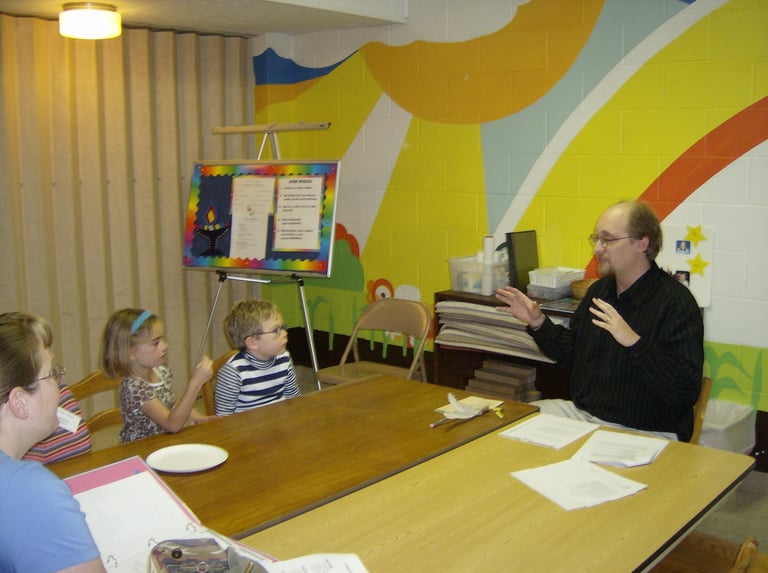
I believe that children need to have tools and resources to make informed choices about religion and spirituality in their life. Hopefully their choice would be Unitarian Universalism! While I am not interested in coercing anyone, child or adult, into joining a UU church, I also think we have historically been too shy about our faith. There is much to be proud of as Unitarian Universalists, and I think it is no shame in sharing that pride with our children (providing it does not cross over into UU triumphalism). Kids need to know about UU history and thought, world religions, and the stories of the Bible. But we also need to educate the parents and adults of the church in all of these things. When adults feel that they have a firm grasp of these topics, then they have a great deal more confidence and effectiveness in their teaching. Thus one important way that a minister can help educate children is by empowering parents and adults for the shared ministry that is teaching in a religious education program. Ministers help teach the teachers.
We should not think of religious education merely as the imparting of intellectual knowledge from one person to another. While this is important, there are other goals as well. I believe that small group ministry is perhaps the greatest tool for spiritual depth and growing that has been developed within Unitarian Universalism. I am a big advocate for covenant and affinity groups as a means of helping people explore their spiritual selves beyond the Sunday morning experience.
One of the benefits of serving a small congregation I experienced was that it gave me the opportunity to teach religious education to children about two or three times a year.For the first few years of my ministry I also attended the Wednesday night YRUU meetings once a month.Often I would teach a small unit on something pertaining to their theme for the year.For adults I have taught Building Your Own Theology, Ethics, and a number of self-made classes on theology, the Bible, and Buddhism.
Leadership Development
Religious Education
Perhaps the single most important role for the minister in a congregation is to help the lay leaders of the church stay grounded in their collective mission and vision for themselves. So often it is tempting in church life to get stuck in the tasks and details. Projects and programs are so complicated, sometimes requiring many volunteers working long hours. This could be anything from putting together the budget to putting together the newsletter. In all these cases the role of the minister is to point out the forest for the trees when everyone else is doing a close examination of the bark on those trees.
Obviously the minister is not the only one doing this most of the time in a congregation. Holding up and referring back to the mission and vision of the church is crucial for the laity to do as well. I would say that anyone, whether they have been to seminary or not, who sees the tasks they are doing for the church as being connected to the larger mission and vision, is a minister. Shared ministry is not about ministers giving up their power so much as it is ministers helping lay people to find their power; their call to ministry. This is our democratic faith at its best.
Keeping the team inspired and on track are my two primary roles. Teamwork is the key in a multi-staff, multi-ministry setting. When those relationships work, then anything is possible. When they breakdown, almost nothing is possible. Unfortunately I have had to discipline staff members and even let one go due to poor performance. While it is never easy, good documentation, honest evaluation, and rock-solid personnel policies and procedures work amazingly well.
In Wilmington my role has been as the chief of staff.Working closely with my fantastic Business Manager, I have learned a lot about leading a team.I meet weekly with the Program Staff for planning and evaluating programs and worship.We also include theological reflection, support and suggestions, and monthly have a discussion on larger issues facing our work.Examples include Adaptive Leadership and Systems theory applied to congregations.I have worked to create a Program Staff Covenant as well as a Senior/Assistant Minister Covenant.These agreements help us identify and work through difficult moments together.Annually I do a retreat with the Program Staff to imagine and innovate new ideas for the coming year.Usually this retreat is done in the week following the annual meeting, and the result is the first draft of a program calendar.This calendar is then used to plan events throughout the year
Leadership and Administration
When you say “Stewardship” to most church folks (UU and otherwise) the first thing they think of is “money.” The first thing I think of is “relationships.” Long before one gets to the drama of an ask for big dollars, and one should, there is the cultivation of relationships. I hasten to add that these have to be genuine relationships; not merely artificial contrivances meant to manipulate people into giving. Even the most socially tone-deaf person can detect such inauthenticity. That and it runs counter to our values as Unitarian Universalists.
No by relationship in the context of stewardship, I mean cultivating relationships among people who care very deeply about our liberal faith and the churches that proclaim it. I believe that such commitment and generosity deserves recognition and appreciation from both the congregation and its minister. This can be a change in culture for most congregations where money is akin to secret keeping. While I do not propose a special cabal of people “in the know” with the minister who happen to be the lead givers, I fear we err too far in the opposite direction most of the time. Frankly, I am curious about people who give large amounts of their money to the church. Why do they do that? What is it about the church that feeds them? How might we do a better job? Simply asking some of our most generous members teaches us a lot about the state of the church and it potential direction. I also believe that every member, regardless of giving level, should be asked such questions and thanked for their generous support of the church.
Stewardship is about developing relationship and sharing a vision and passion for the church. The ask for money is simply a reminder of the difference the church has made in that person’s life. It is an opportunity to give to the church’s vision, rather than to merely its need. For the past two years we have been doing “Stewardship Reflections” to remind people in worship of the difference the church makes in their life just before we collect the offering.
In Omaha my involvement in the stewardship campaign was pretty minimal.I would do the standard “sermon on the amount” and pretty much leave it to the canvassers to do their thing.The Board would work up a budget, and I made suggestions whenever possible.We were also horribly out of alignment with our mission and vision!In Wilmington I have taken a more hands on approach with the stewardship campaign.The Business Manager and I are the principal architects of the budget.I have also begun taking to some of the lead givers of the church.Often one of the Stewardship Team members and I solicit the gifts of the top twenty or so givers in a given year.I also have taken to handwriting a personal thank you to about half the givers in the church
Contact:
revdrjoshsnyder@gmail.com
(302) 358-1790
© 2025. All rights reserved.
References available upon request